
What Are the Common Strain Types in Materials?


The common strain types in materials are normal, tensile, compressive, shear, volumetric, lateral, thermal, residual, elastic, and plastic strain, each describing a specific deformation mode relevant to engineering design and material selection. Strain quantifies how much a material stretches, compresses, or distorts under mechanical, thermal, or other physical influences, and the result is always a dimensionless quantity expressed as the ratio of change in dimension to the original dimension. Metals (steel, aluminum), polymers (PLA, nylon), and composites (carbon fiber reinforced polymer, glass fiber reinforced polymer) each exhibit distinct strain behaviors depending on their atomic structure, bonding, and microstructure. The stress-strain relationship, governed by Hooke's Law within the elastic region, defines how a material returns to its original shape after load removal, provided strain does not exceed the elastic limit.
Strain is directly related to stress, elasticity, and plasticity, forming the basis of mechanical analysis in structural and manufacturing engineering. Elasticity describes the recoverable strain a material experiences below its elastic limit, while plasticity describes the permanent strain that occurs once the yield strength is exceeded. Beyond the yield point, plastic deformation occurs, resulting in a permanent shape change that cannot be reversed upon load removal. Understanding the common strain types in materials is foundational to predicting material performance across aerospace, automotive, civil, and manufacturing engineering applications.
Types of Strain in Mechanics and Materials
Types of strain in mechanics and materials are listed below.
- Normal Strain: Deformation that occurs perpendicular to the cross-sectional plane of a material, manifesting as either stretching (tensile) or compression (compressive).
- Tensile Strain: Strain produced when a material is subjected to stretching forces, leading to an increase in length.
- Compressive Strain: Strain produced when a material is subjected to compressive forces, leading to a decrease in length.
- Shear Strain: The angular deformation (measured in radians) that occurs when forces are applied parallel to the surface of a material, causing a change in the original right angle between two lines.
- Volumetric Strain: The ratio of the change in volume to the original volume (delta V over V) resulting from applied stress.
- Lateral Strain: The strain occurring in the direction perpendicular to the applied force, often measured in the lateral direction of a specimen under uniaxial stress.
- Thermal Strain: Strain caused by the expansion or contraction of a material when there is a change in temperature.
- Residual Strain: Strain that remains in a material after the external load or force has been removed, due to plastic deformation.
- Elastic Strain: Strain in which the material returns to its original shape once the applied force is removed, occurring within the material's elastic limit.
Plastic Strain: Permanent deformation that occurs after the material has exceeded its yield point, where it does not return to its original shape after the load is removed.
1. Normal Strain
Normal strain describes how a solid material responds to a force that is applied perpendicular to its cross-sectional area. It is measured as the ratio of the change in length to the original length of the material. The formula for normal strain is:
ε = ΔL / L₀
Understanding normal strain is crucial for designing and testing materials in various industries. It helps ensure the safety and reliability of structures and products.
2. Tensile Strain
Tensile strain is the amount of deformation that a material undergoes when it is pulled or stretched. It is measured as the ratio of the change in length of the material to its original length. The formula for tensile strain is:
ε = ΔL / L₀
The measurement of tensile strain is important in materials science and engineering, as it helps to determine a material's ductility and elasticity.
3. Compressive Strain
Compressive strain is the deformation that takes place in a material when it is subjected to a contracting force. Under compression, the space between the atoms of a material is reduced, causing the material to become compacted. It is measured by comparing the original and deformed lengths of a test specimen or structure under compression. The formula for compressive strain is:
ε = ΔL / L₀
Compressive strain is important in materials science as it helps determine a material's compressive strength and its ability to resist deformation.
4. Shear Strain
Shear strain is a type of strain that occurs when the particles of a material slide past each other in a parallel direction, causing a change in the shape of the material. It is measured as the change in angle between two originally perpendicular lines in the material. The formula for shear strain is given by:
γ = tan θ
Where:
γ is the shear strain
θ is the shear angle
Shear strain is used in the design of various structures and mechanical systems.
5. Volumetric Strain
Volumetric strain is the term for the volume change that occurs in a material as a result of uniformly applied external forces (hydrostatic strain). It is determined by dividing the volume change by the starting volume. The formula for calculating volumetric strain is:
ε = ΔV/V
Where:
ΔV is the change in volume
V is the volume
Volumetric strain is important in various fields such as engineering, geology, and materials science. It aids in predicting how materials will react to stress and in designing structures appropriately.
6. Lateral Strain
Lateral strain refers to the strain perpendicular to the applied axial load, describing the contraction or expansion of a material's cross-section under longitudinal stress. The ratio of lateral strain to axial strain defines Poisson's ratio (ν), a fundamental material property typically ranging from 0.25 to 0.35 for metals. A steel bar under tensile load contracts laterally by a factor determined by its Poisson's ratio.
7. Thermal Strain
Thermal strain arises from dimensional changes caused by temperature variation, expressed as εₜ = α × ΔT, where α is the coefficient of thermal expansion (CTE), and ΔT is the temperature change. Steel has a CTE typically ranging from 10 to 18 × 10⁻⁶/°C, meaning a 1-meter rod expands by 10 to 18 micrometers per degree Celsius of temperature increase, depending on the specific alloy grade. Thermal strain is a critical design consideration in structures exposed to temperature cycling.
8. Residual Strain
The term residual strain describes the persistent deformation that remains in a material after the external load or source of temperature gradient has been removed. It can be measured using techniques such as X-ray diffraction or neutron diffraction. Residual strain is calculated using Bragg’s Law, nλ = 2d sin θ, to measure the change in interplanar lattice spacing (d) compared to a stress-free reference. An accurate measure of residual strain can help an engineer understand the residual stress state in a structure, providing needed information for avoiding potential failures. It can also provide valuable information for improving manufacturing processes and designing structures with enhanced performance.
9. Elastic Strain
Elastic strain is a recoverable deformation that disappears when the applied load is removed, occurring within the elastic region of the stress-strain curve below the yield point. For metals, elastic strain is typically less than 0.2% (0.002 m/m) before yielding begins. Elastic strain obeys Hooke's Law: ε = σ/E, where σ is stress and E is the elastic modulus.
10. Plastic Strain
Plastic strain is a permanent, non-recoverable deformation that occurs when stress exceeds the material's yield strength, resulting in irreversible changes to the crystal structure or molecular arrangement. Metals undergo plastic strain through dislocation movement within the crystal lattice, while polymers experience chain slippage or realignment. Plastic strain is quantified as the total strain minus the elastic strain recovered after load removal.
What is the Importance of Strain in Materials?
The importance of strain in materials is its ability to quantify deformation, predict structural behavior, and determine whether a material operates safely under applied loads. Measuring and analyzing strain allows engineers to determine whether a material operates within its elastic limit or has entered plastic deformation, which directly affects the safety and service life of a component. Without strain data, it is not possible to accurately predict how a material responds under real operating loads. Strain values feed into finite element analysis (FEA) models used to simulate component behavior, enabling design optimization before physical prototyping. The relationship from stress to strain, governed by the elastic modulus (E = σ/ε), provides the foundational data needed for material selection across aerospace, automotive, civil, and manufacturing industries.
How Does Strain Analysis Help Prevent Material Failure or Deformation?
Strain analysis helps prevent material failure by identifying stress concentrations, deformation patterns, and regions where strain exceeds safe operating limits before catastrophic failure occurs. Engineers map strain distribution across a component's surface with spatial resolution as fine as 0.1 mm through experimental methods (strain gauge measurement or digital image correlation). Regions exhibiting strain values approaching the ultimate strain of the material are flagged for redesign or reinforcement. In structural steel, the yield strain is approximately 0.1% to 0.25%, and components are designed to operate well below the threshold under normal service loads. Strain analysis validates FEA simulations, ensuring computational models accurately reflect real-world deformation behavior, which reduces the likelihood of premature failure due to design error.
Can Neglecting Strain Measurements Compromise Safety?
Yes, neglecting strain measurements can compromise safety by allowing components to operate under unknown deformation conditions that exceed design limits. Structural failures (brittle fracture, fatigue cracking, and plastic collapse) cannot be predicted or prevented effectively without strain data. The Aloha Airlines Flight 243 incident in 1988 and multiple bridge collapses have been attributed, in part, to inadequate monitoring of structural deformation over time. Strain monitoring in critical infrastructure (bridges, pressure vessels, aircraft frames) reduces unexpected failure risk by providing real-time deformation data that triggers maintenance or load reduction before failure occurs.
What is the Use of Strain in Mechanics?
The use of strain in mechanics quantifies deformation as a basis for calculating stress, predicting material behavior, and ensuring structural safety under applied loads. In mechanical analysis, strain data obtained from experimental measurements or computational simulations enable engineers to determine the internal stress state of a component using constitutive relationships such as Hooke's Law (σ = Eε) for linear elastic materials. Strain is a direct input in calculating the elastic modulus, Poisson's ratio, and shear modulus of materials, which are required for structural design calculations. The analysis of strain distributions guides decisions on material selection, component geometry, and safety factors in mechanical systems ranging from microelectronics to heavy machinery.
How Is Strain Used in Mechanical Design and Optimization?
Strain is used in mechanical design and optimization to ensure components withstand applied loads without exceeding yield strength or fatigue limits. During the design phase, FEA software calculates strain fields across complex geometries, identifying regions of peak strain concentration that require design modification. A notch or hole in a structural component creates local strain concentrations that reach 2 to 3 times the nominal strain, a factor quantified by the strain concentration factor (Ke). Optimizing geometry to reduce strain concentration through fillets, radii, and gradual cross-section transitions extends fatigue life. Physical strain gauge testing on prototypes validates FEA predictions and ensures that actual strain values under service loads remain within acceptable limits defined by the material's yield strain and fatigue strength.
Can Strain Measurements Predict Fatigue in Materials?
Yes, strain measurements can predict fatigue in materials by linking cyclic strain amplitudes to the number of cycles to failure through the strain-life (ε-N) curve (Coffin-Manson relationship). The Coffin-Manson equation relates plastic strain amplitude (Δεₚ/2) to fatigue life (2Nf), providing a quantitative basis for predicting failure under cyclic loading. For high-cycle fatigue (above 10⁵ cycles), elastic strain dominates, while plastic strain governs low-cycle fatigue (typically below 10⁴ to 10⁵ cycles). Real-time strain monitoring using strain gauges or fiber Bragg grating sensors tracks cumulative strain history, enabling fatigue life estimation through rainflow counting algorithms.
How is Strain Measured in Mechanics?
Strain in mechanics is measured using electrical resistance strain gauges, optical methods, and non-contact digital systems, each suited to specific applications and accuracy requirements. Electrical resistance strain gauges operate on the principle that the electrical resistance of a metallic conductor changes proportionally to its deformation, with a gauge factor (GF) typically ranging from 2.0 to 2.1 for foil gauges. The strain is calculated as ε = ΔR / (GF × R₀), where ΔR is the change in resistance, and R₀ is the original resistance. Digital image correlation (DIC) uses high-resolution cameras and speckle patterns to measure full-field surface strain with accuracy down to 0.001% strain. Fiber Bragg grating (FBG) sensors embedded in composite materials measure internal strain by detecting shifts in reflected light wavelength caused by deformation. Extensometers attached directly to specimens measure elongation during tensile testing with resolution as fine as 0.001 mm.
Can Strain Be Measured During Motion or Dynamic Loading?
Yes, strain can be measured during motion or dynamic loading using high-frequency data acquisition systems paired with strain gauges, telemetry systems, or non-contact optical sensors. Dynamic strain gauges operate at sampling rates from 10 kHz to over 1 MHz, capturing transient strain events such as impact loads, vibrations, and shock waves. Rotating components (shafts, turbine blades) require wireless telemetry systems or slip-ring assemblies to transmit strain data without physical cable constraints. Digital image correlation systems equipped with high-speed cameras capture dynamic strain fields at frame rates exceeding 100,000 frames per second in research applications. Dynamic strain measurement is applied in crash testing, fatigue testing, and structural health monitoring of rotating machinery.
What Are the Units of Strain?
The units of strain are m/m, in/in, or mm/mm, as strain represents the change in dimension divided by the original dimension, all of which reduce to a dimensionless pure number. In practice, strain values are expressed in microstrain (με), where 1 με = 1 × 10⁻⁶ m/m, because elastic strains in engineering materials are typically very small. A steel component at its yield point experiences approximately 1,000 to 2,000 με, while brittle ceramics fracture at strains below 1,000 με. Shear strain is also dimensionless, expressed in radians as the tangent of the deformation angle. Thermal strain is expressed in the same dimensionless format: ε = α × ΔT, where α has units of 1/°C, and ΔT is in °C, yielding a dimensionless product.
Why Does the Strain in Materials Need To Be Measured?
Strain in materials needs to be measured because it verifies that materials and structures perform within their designed mechanical limits under real operating conditions. Without direct strain measurement, engineers may be forced to rely heavily on theoretical calculations, which carry assumptions about material homogeneity and boundary conditions that do not always reflect real-world variability. Measured strain data validates analytical and computational models, reducing uncertainty in safety factor determinations. Strain measurement also detects the onset of plastic deformation (permanent damage) before visible cracking or fracture occurs, providing early warning of structural degradation. In manufacturing quality control, strain measurement confirms that forming, welding, or heat treatment processes produce parts within specified dimensional and mechanical tolerances.
How Is Strain Measurement Important in Quality Control?
Strain measurement is important in quality control by manufacturing, confirming that fabricated components meet mechanical performance specifications before entering service. Strain measurements define the yield strength, ultimate tensile strength, and elongation at break of a material batch during tensile testing per ASTM E8 (metals) or ISO 6892-1 standards. Deviations from specified strain response indicate material defects such as porosity, inclusions, or incorrect heat treatment. In sheet metal forming, strain gauges and DIC systems verify that forming strains remain below the forming limit curve (FLC) of the material, preventing cracking or thinning defects. Residual strain measurement in welded or machined components ensures that manufacturing-induced stresses do not compromise fatigue life in service.
How Does Monitoring Strain Help Predict Material Failure?
Monitoring strain helps predict material failure by tracking deformation accumulation over time and identifying when strain approaches critical thresholds associated with fracture, yielding, or fatigue damage. Continuous strain monitoring on bridges using fiber Bragg grating arrays detects progressive deformation caused by traffic loads, settlement, or corrosion-induced section loss. In pressure vessels, strain gauge rosettes measure biaxial strain states, allowing calculation of principal stresses and the subsequent determination of stress intensity factors to be compared with fracture toughness criteria (KIC values). Acoustic emission sensors detect micro-strain events caused by crack initiation, providing early failure warning before macro-crack propagation. Predictive maintenance programs integrate strain history data with fatigue life models to schedule inspections and replacements before failure occurs.
Can Strain Monitoring Prevent Unexpected Failures?
Yes, strain monitoring can prevent unexpected failures by providing real-time deformation data that enables intervention before strain reaches failure thresholds. Structural health monitoring (SHM) systems on bridges, aircraft, and offshore platforms use distributed strain sensor networks to detect anomalous strain patterns indicative of damage, overloading, or fatigue crack growth. The Federal Aviation Administration (FAA) mandates structural health monitoring on aging aircraft fleets to detect fatigue damage before critical failure. Studies on monitored steel bridges show that SHM systems detect crack-related strain anomalies at crack lengths as small as 1 to 2 mm, well before visible inspection methods can identify damage. Real-time strain alerts trigger load reductions, maintenance actions, or structural reassessments that prevent catastrophic failure.
What Are the Causes of Strain in Materials?
The causes of strain in materials are listed below.
- Mechanical Loading: A tensile load of 100 kN on a 100 mm² steel cross-section produces a stress of 1,000 MPa; in high-strength steel with E = 210 GPa, this would theoretically generate an elastic strain of approximately 0.48% if the material has not yet yielded.
- Thermal Expansion and Contraction: Temperature changes cause materials to expand or contract according to their coefficient of thermal expansion (CTE). Aluminum (CTE of approximately 23 × 10⁻⁶/°C) expands nearly twice as fast as steel (CTE of approximately 12 × 10⁻⁶/°C) under the same temperature change, creating thermal strains at joints from dissimilar metals.
- Phase Transformations: Solid-state phase changes (martensitic transformation in steel, solidification shrinkage in casting) produce volumetric strain due to density differences from the parent to product phase. Martensitic transformation in steel involves a volume increase of approximately 2 to 4%, generating compressive residual strains in the surrounding austenitic matrix.
- Moisture Absorption: Hygroscopic materials (wood, nylon, concrete) absorb moisture and expand, generating swelling strains. Nylon 6/6 absorbs up to 8.5% moisture by weight at saturation, producing dimensional changes of approximately 1.5 to 3% in affected directions.
- Residual Manufacturing Stresses: Processes (welding, machining, cold working, and heat treatment) introduce residual strains through non-uniform plastic deformation or differential cooling rates. Welding creates tensile residual strains at the weld toe that reduce fatigue strength by as much as 50% compared to unstressed base metal.
- Creep: Steel at temperatures above 40% of its absolute melting point (approximately 450°C to 500°C for carbon steel) begins to exhibit measurable creep strain under sustained loads.
How Do Mechanical Forces Cause Strain in Materials?
Mechanical forces cause strain by deforming the atomic bonds and crystal lattice (in metals) or molecular chains (in polymers) of a material when stress is applied. Tensile forces stretch interatomic bonds beyond their equilibrium spacing at the atomic scale, while compressive forces compress them, producing elastic strain recoverable upon load removal. Dislocations in metallic crystal structures move irreversibly through the lattice, producing permanent plastic strain when stress exceeds the yield strength. The magnitude of strain produced by a given force depends on the material's elastic modulus (E), yield strength (σᵧ), and cross-sectional geometry. Under a stress of 200 MPa, a steel component (E = 200 GPa) experiences an elastic strain of 0.1%, while the same stress applied to aluminum (E = 70 GPa) produces a strain of approximately 0.29%.
Can Applied Forces Deform Materials?
Yes, applied forces can deform materials by inducing internal stresses that cause atomic-scale displacement, resulting in measurable dimensional changes at the macroscopic level. Every material deforms under sufficient force, and the degree of deformation depends on the force magnitude, direction, duration, and the material's mechanical properties (E, σᵧ, fracture toughness). Elastic deformation occurs in all engineering materials under any non-zero load, even if the deformation is too small to measure without precision instruments. Plastic deformation begins once applied stress exceeds the material's yield strength (250 MPa for mild steel, 35 MPa for 6061-T6 aluminum in the annealed condition, and as low as 5 to 15 MPa for soft polymers).
What Are the Effects of Strain on Materials?
The effects of strain on materials are listed below.
- Work Hardening (Strain Hardening): Plastic strain increases dislocation density in metallic materials, raising yield strength and hardness while reducing ductility. Cold-worked copper increases yield strength from approximately 70 MPa (annealed) to 340 MPa at 50% cold reduction, a 386% increase.
- Dimensional Change: All strain types produce dimensional changes, from elastic elongation under tensile load to permanent shape change following plastic deformation. Dimensional changes from thermal strain accumulate over time in structures subject to repeated thermal cycling.
- Microstructural Damage: High plastic strain causes void nucleation and coalescence at grain boundaries and second-phase particles, ultimately leading to ductile fracture. Strain localisation in shear bands precedes fracture in high-strength steels and metallic glasses.
- Residual Stress Introduction: Non-uniform plastic strain introduces residual stresses that alter fatigue life, corrosion resistance, and dimensional stability. Compressive residual stresses introduced by shot peening improve the fatigue life of steel components by 20 to 300%.
- Property Degradation in Polymers: Plastic strain in thermoplastics causes chain orientation, whitening (stress whitening), and reduction in impact resistance. Polypropylene exhibits stress whitening at strains above approximately 5 to 8%, indicating the onset of void formation.
- Fracture: Strain exceeding the material's fracture strain causes either ductile fracture (preceded by necking and void growth) or brittle fracture (sudden crack propagation with minimal plastic deformation). The elongation at break of 1020 steel in tension is approximately 25 to 35%, while that of gray cast iron is below 1%.
How Does Strain Change the Physical Properties of Materials?
Strain changes physical properties through microstructural modification, atomic bond distortion, and changes in material density and phase distribution. Elastic strain temporarily alters interatomic spacing, changing electrical resistivity, thermal conductivity, and magnetic properties in a recoverable manner. Plastic strain permanently alters grain shape, dislocation density, and texture, producing anisotropic mechanical properties (different strengths in different directions). Cold-rolling steel sheet increases yield strength by 30 to 100% in the rolling direction while reducing ductility from 25% to as low as 5% elongation. In piezoelectric materials (quartz, PZT ceramics), elastic strain produces a measurable electric polarization, a phenomenon that forms the basis of strain sensors and actuators.
Can Excessive Strain Lead to Material Failure?
Yes, excessive strain can lead to material failure through yielding, fracture, fatigue crack initiation, or creep rupture, depending on the loading conditions and material type. When total strain exceeds the fracture strain of a material, crack initiation and propagation occur, resulting in complete separation of the component. Brittle materials (ceramics, glass) fracture at strains below 0.1% with little or no plastic deformation, while ductile metals (annealed copper, mild steel) tolerate strains of 20 to 50% before fracture. Cyclic strains above the fatigue limit of a material cause progressive crack growth even at strains well below the monotonic fracture strain, with crack growth rates described by the Paris Law: da/dN = C(ΔK)ᵐ. Creep rupture occurs when sustained high-temperature strain accumulates to the material's creep ductility limit, 1 to 10% for metals under creep conditions.
What is the Formula for Strain?
The formula for strain (ε) is:
ε = ΔL / L₀
Where:
ε = normal strain (dimensionless)
ΔL = change in length (deformed length minus original length), in meters or millimeters
L₀ = original (undeformed) length, in meters or millimeters
The formula yields a dimensionless ratio, commonly expressed in m/m, mm/mm, or microstrain (με, where 1 με = 10⁻⁶). For shear strain, the formula is γ = Δx/h = tan(φ), where φ is the deformation angle in radians. Volumetric strain is expressed as εᵥ = ΔV/V₀ = ε₁ + ε₂ + ε₃ for orthotropic materials. Thermal strain is εₜ = α × ΔT, where α is the CTE in 1/°C, and ΔT is the temperature change in °C.
How is Strain Calculated?
Strain is calculated by dividing the measured change in dimension by the original dimension of the material before loading. For a steel rod with an original length of 500 mm that elongates to 500.5 mm under tensile load, the normal strain is: ε = (500.5 − 500) / 500 = 0.001 m/m = 1,000 με. For shear strain calculation, the lateral displacement (Δx) of a material layer divided by its thickness (h) gives γ = Δx/h. In multi-axial stress states, strain components are calculated using the generalized Hooke's Law equations that account for Poisson's ratio effects in all three orthogonal directions. FEA software automates strain calculation by solving the equilibrium equations at thousands to millions of nodes across the component geometry.
Can Strain Be Calculated From Measured Elongation and Original Length?
Yes, strain can be calculated from measured elongation and original length using the formula ε = ΔL/L₀, making elongation measurement the most direct experimental method for strain determination. In a standard tensile test per ASTM E8, an extensometer measures elongation of a gauge length (typically 50 mm for metals) while the load cell records applied force, enabling simultaneous calculation of stress and strain throughout the test. For a 50 mm gauge length specimen that elongates by 2.5 mm at fracture, the engineering elongation at break is: ε = 2.5/50 = 0.05 m/m = 5%. Digital extensometers achieve measurement resolution of 0.001 mm, enabling accurate strain measurement even in the elastic region where deformations are below 0.1 mm for typical laboratory specimens.
What is Strain in Hooke’s Law?
Strain in Hooke's Law is the proportional deformation response of a linearly elastic material to applied stress, expressed as ε = σ/E, where ε is normal strain, σ is normal stress in Pa or MPa, and E is the elastic (Young's) modulus in Pa or GPa. Hooke's Law applies within the elastic region of the stress-strain curve, where strain increases linearly with stress and full recovery occurs upon load removal. For steel (E = 200 to 210 GPa), a stress of 200 MPa produces an elastic strain of approximately 0.001 m/m (1,000 με). For shear loading, Hooke's Law takes the form τ = Gγ, where τ is shear stress, G is the shear modulus, and γ is shear strain. The law was formulated by Robert Hooke in 1678 and remains the foundational constitutive equation for linear elastic material behavior.
What 3D Printing Materials Handle Strain Well?
The 3D printing materials that handle strain well are listed below.
- Steel: Steel has a high elastic modulus (190 to 210 GPa) and yield strength of 250 to 1,500 MPa, with 316L stainless steel printed via SLM achieving elongation at break typically between 25% and 35%. The strain characteristics of steel are covered within the properties of Steel.
- Aluminum: Aluminum alloys offer a moderate elastic modulus (68 to 72 GPa) and yield strengths of 95 to 570 MPa, with AlSi10Mg printed via SLM achieving elongation at break of 3 to 8%. The strain characteristics of aluminum alloys are detailed within the properties of Aluminum.
- Concrete: Concrete exhibits a compressive strain capacity of 0.003 to 0.0035 m/m (3,000 to 3,500 με) before crushing, with negligible tensile strain capacity (approximately 0.0001 m/m) before cracking. The strain behavior of 3D-printed concrete is covered within the properties of Concrete.
- Plastics: Engineering plastics range from brittle thermosets (epoxy, fracture strain 1 to 3%) to highly ductile thermoplastics (HDPE, fracture strain 100 to 1,000%), with elastic moduli from 0.1 GPa (soft elastomers) to 3.5 GPa (rigid PLA). The mechanical strain behavior of printed plastics is covered within the resources for Plastic.
- Ceramics: Ceramics are brittle materials with fracture strains typically below 0.1% and elastic moduli from 70 to 400 GPa, retaining the same brittle strain behavior in 3D-printed form (binder jetting, stereolithography). The strain limitations of ceramic materials are fundamental to understanding the properties of Ceramics.
1. Steel
Steel handles strain through a combination of high elastic modulus (190 to 210 GPa), significant yield strength (250 to 1,500 MPa depending on grade), and substantial plastic deformation capacity before fracture. 316L stainless steel printed via selective laser melting (SLM) achieves yield strengths typically between 300 and 450 MPa with elongation at break of 20 to 35%, slightly lower than wrought annealed material. The high ductility of steel allows significant energy absorption through plastic strain before structural failure, making it suitable for load-bearing applications. Steel is one of the primary engineering materials characterized by a well-defined elastic and plastic strain behavior in the context of Steel.
2. Aluminum
Aluminum alloys balance low density (2.7 g/cm³) with moderate elastic modulus (68 to 72 GPa) and yield strengths of 95 to 570 MPa depending on alloy and temper. AlSi10Mg printed via SLM achieves yield strengths of 230 to 330 MPa with elongation at break of 3 to 8%, lower than wrought aluminum due to microstructural porosity and residual thermal strains from the printing process. Aluminum's moderate elastic modulus means it undergoes approximately 2.8 times more elastic strain than steel under the same stress, a relevant consideration in stiffness-critical designs. The strain characteristics of aluminum alloys are detailed within the properties of Aluminum.
3. Concrete
Concrete exhibits compressive strain capacity of 0.003 to 0.0035 m/m (3,000 to 3,500 με) before crushing, with negligible tensile strain capacity (approximately 0.0001 m/m) before cracking. The elastic modulus of concrete ranges from 17 to 31 GPa, depending on compressive strength, significantly lower than that of metals. Reinforcing steel bars (rebar) are embedded in concrete structures to carry tensile strain, creating reinforced concrete with composite strain behavior. 3D-printed concrete (contour crafting) uses portland cement or geopolymer mixes with compressive strengths of 20 to 60 MPa.
4. Plastics
Engineering plastics cover a wide range of strain capacities, from brittle thermosets (epoxy, fracture strain 1 to 3%) to highly ductile thermoplastics (HDPE, fracture strain 100 to 1,000%). The elastic modulus of common plastics ranges from 0.1 GPa (soft elastomers) to 3.5 GPa (rigid PLA), with yield strains typically from 2 to 10%. Plastics are extensively used in fused deposition modeling (FDM) and selective laser sintering (SLS) printing, where residual thermal strains from differential cooling affect dimensional accuracy. The mechanical strain behavior of printed plastics is covered within the resources for Plastic.
5. Ceramics
Ceramics are brittle materials with fracture strains typically below 0.1%, elastic moduli from 70 to 400 GPa, and compressive strengths 10 to 15 times their tensile strengths. Ceramics have virtually no plastic strain capacity, fracturing catastrophically once stress exceeds their modulus of rupture. 3D-printed ceramics (binder jetting, stereolithography of ceramic slurries) retain the same brittle strain behavior as conventionally processed ceramics. The strain limitations of ceramic materials are fundamental to understanding the properties of Ceramics.
Which 3D Printing Polymers Resist Strain?
The 3D printing polymers that resist strain are listed below.
- PLA (Polylactic Acid): The PLA has a tensile modulus of 2.0 to 3.5 GPa and elongation at break of 3 to 6%, making it rigid but brittle, as further detailed in PLA (Polylactic Acid).
- ABS (Acrylonitrile Butadiene Styrene): The ABS (Acrylonitrile Butadiene Styrene): The ABS has a tensile modulus of 2.0 to 2.4 GPa and elongation at break of 5 to 25%, offering better ductility than PLA, as covered in ABS Plastic (Acrylonitrile Butadiene Styrene).
- Nylon: The nylon has a tensile modulus of 1.5 to 3.3 GPa (dry) and elongation at break of 30 to 300%, providing excellent strain tolerance, as described in Types of Nylon.
- PETG (Polyethylene Terephthalate Glycol): The PETG (Polyethylene Terephthalate Glycol): The PETG has a tensile modulus of 1.9 to 2.3 GPa and elongation at break of 50 to 100%, combining moderate stiffness with high ductility, as covered in Polyethylene Terephthalate.
- TPU (Thermoplastic Polyurethane): The TPU has a tensile modulus of 0.004 to 0.4 GPa and elongation at break of 300 to 800%, providing exceptional strain tolerance for flexible applications, as detailed in TPU 3D Printing Service in Materials Used in 3D Printing.
1. PLA (Polylactic Acid)
LA is a semi-crystalline thermoplastic with a tensile modulus of 2.0 to 3.5 GPa, tensile strength of 50 to 65 MPa, and an elongation at break of 3 to 6%, making it relatively rigid but brittle compared to other FDM polymers. PLA exhibits low creep resistance due to its glass transition temperature (Tg) of approximately 55 to 60°C, limiting its use in elevated-temperature environments where thermal strains are present. The strain capacity of printed PLA is reviewed in detail for PLA (Polylactic Acid).
2. ABS (Acrylonitrile Butadiene Styrene)
ABS offers a tensile modulus of 2.0 to 2.4 GPa, tensile strength of 40 to 50 MPa, and elongation at break of 5 to 50%, providing better ductility than PLA and greater resistance to plastic strain accumulation under impact loading. The butadiene rubber phase in ABS absorbs impact energy through local plastic strain, improving toughness at the cost of slightly lower stiffness. The mechanical strain properties of ABS (Acrylonitrile Butadiene Styrene) are directly relevant to applications requiring ductile strain response.
3. Nylon
Nylon (polyamide) exhibits a tensile modulus of 1.5 to 3.3 GPa (dry), tensile strength of 50 to 85 MPa, and elongation at break of 30 to 300%, providing excellent strain tolerance and fatigue resistance. Nylon absorbs moisture (up to 8.5% for Nylon 6/6), which plasticizes the polymer matrix and increases elongation at break while reducing tensile modulus and strength, a relevant consideration in humid service environments. The strain behavior of the Nylon used in 3D printing varies significantly from the dry to the moisture-conditioned state.
4. PETG (Polyethylene Terephthalate Glycol)
PETG has a tensile modulus of 1.9 to 2.3 GPa, tensile strength of 50 to 55 MPa, and elongation at break of 50 to 100%, combining moderate stiffness with high ductility and good chemical resistance. The glycol modification in PETG reduces crystallinity compared to standard PET, increasing amorphous content and improving impact strain resistance while maintaining dimensional stability. The strain and mechanical properties of Polyethylene Terephthalate variants are relevant to printed structural components requiring both strength and deformation tolerance.
5. TPU (Thermoplastic Polyurethane)
TPU is an elastomeric thermoplastic with a tensile modulus of 0.004 to 0.4 GPa, tensile strength of 25 to 55 MPa, and elongation at break of 300 to 800%, providing exceptional strain tolerance and elastic recovery for flexible, impact-absorbing applications. TPU behaves as a hyperelastic material at large strains, maintaining load-carrying capacity well beyond the strain limits of rigid thermoplastics. The elastic strain recovery properties of TPU are central to its applications in TPU (Thermoplastic Polyurethane) for flexible and wearable components.
What Are the Benefits of Strain Analysis?
The benefits of strain analysis are listed below.
- Failure Prevention: Strain analysis identifies regions of excessive deformation before catastrophic failure, enabling redesign or reinforcement of critical components. Strain gauge data from fatigue-tested specimens validates material fatigue models, reducing unexpected service failures.
- Design Optimization: Strain field data from FEA and experimental DIC identifies over-designed (low-strain) regions where material removal reduces weight without compromising safety. Aerospace components optimized through strain analysis achieve weight reductions of 10 to 30% compared to conservatively designed equivalents.
- Material Selection Support: Strain analysis quantifies the deformation behavior of candidate materials under realistic service loads, enabling objective comparison of material performance. Experimental strain data confirms whether a material's measured elastic modulus and yield strain match supplier specifications.
- Quality Assurance: Strain measurement during proof testing or acceptance testing verifies that manufactured components meet mechanical performance requirements before entering service. Deviations from expected strain response indicate manufacturing defects, incorrect material, or inadequate heat treatment.
- Structural Health Monitoring: Continuous strain monitoring on in-service structures tracks deformation trends over time, identifying progressive damage accumulation before failure. SHM systems on wind turbine blades use FBG sensors to monitor operational strain and detect fatigue damage in real time.
- Process Validation: Strain measurement during manufacturing processes (forming, welding, additive manufacturing) verifies that process parameters produce acceptable residual stress states in finished components. Forming strain analysis confirms that sheet metal components stay within the forming limit curve (FLC) of the material, preventing splitting or necking defects.
"Effective material selection requires more than reviewing static data sheets: it demands an understanding of how process-induced residual states interact with operational loads (a critical pillar of DFM). Precise application of GD&T ensures that geometric transitions do not become sites for premature material fatigue: this high-level process optimization transforms theoretical design into a resilient manufacturing reality."
What Are the Limitations of Strain Analysis?
The limitations of strain analysis are listed below.
- Measurement Area Constraints: Electrical resistance strain gauges measure strain only at the discrete point of gauge attachment, missing strain gradients from one gauge location to another. Point measurement is inadequate for components with complex strain distributions unless a dense gauge array (20 or more gauges) is deployed.
- Surface-Only Measurement: Most experimental strain measurement techniques (strain gauges, DIC, photoelasticity) measure surface strain only, not internal strain states. Subsurface strain concentrations at internal defects, inclusions, or interfaces require X-ray diffraction, neutron diffraction, or destructive sectioning methods.
- Sensitivity to Installation Quality: Strain gauge accuracy depends critically on correct surface preparation, adhesive application, and gauge alignment. Misalignment of a gauge by 5° from the principal strain direction introduces a measurement error of approximately 2 to 3% in the principal strain reading.
- Temperature Sensitivity: Strain gauges are sensitive to temperature changes that alter gauge resistance independently of mechanical strain, introducing apparent strain errors. Temperature compensation circuits and dummy gauges are required for accurate measurement in environments with temperature fluctuations exceeding ±5°C.
- Destructive Residual Strain Measurement: The hole-drilling method for residual strain measurement is semi-destructive, introducing a permanent hole into the component. Non-destructive alternatives (X-ray diffraction) measure only near-surface residual strains (typically 5 to 20 μm depth) and require access to expensive laboratory or portable diffractometer equipment.
- Model Dependency in FEA: Computational strain analysis accuracy depends on correct material constitutive models, mesh density, and boundary condition definition. An incorrect elastic modulus input of 5% produces a proportional 5% error in computed strain, and nonlinear material behavior requires more complex plasticity models.
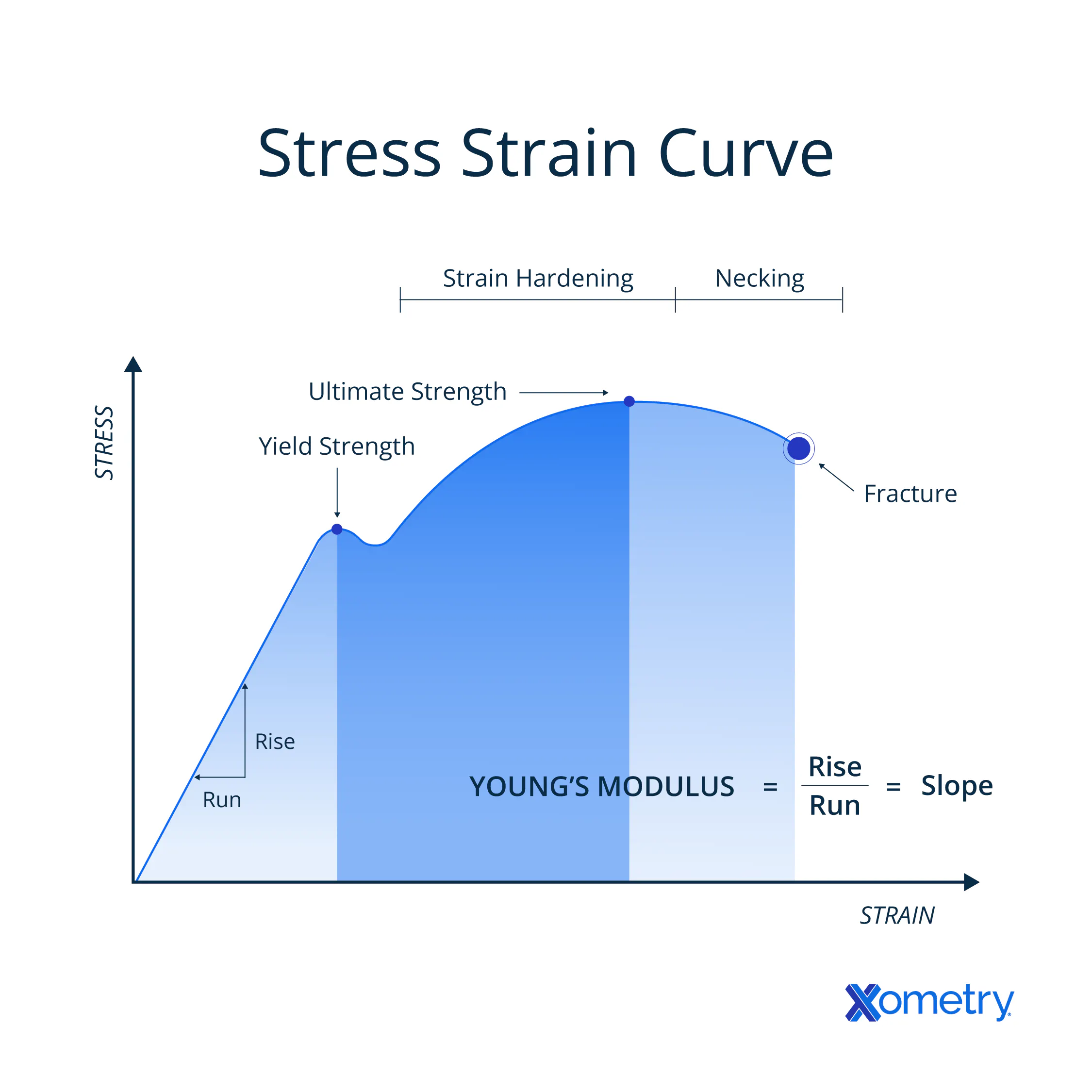
What Does a Stress or Strain Curve Show?
A stress or strain curve shows the relationship from applied stress (σ, in MPa) to resulting strain (ε, dimensionless) in a material specimen tested under controlled loading, revealing key mechanical properties across the elastic and plastic deformation regions. The initial linear region of the curve represents elastic behavior, where the slope equals the elastic (Young's) modulus (E = σ/ε). The proportional limit marks the end of perfect linearity, followed by the elastic limit (the maximum stress for full recovery upon unloading) and the yield point (where measurable plastic deformation begins at yield strength values such as 250 MPa for mild steel). The plastic region extends from yielding to the ultimate tensile strength (UTS), the highest point on the engineering stress-strain curve, where necking begins in ductile metals. Beyond the UTS, the engineering stress decreases due to cross-sectional area reduction at the neck until fracture occurs at the elongation at break. The area under the entire stress-strain curve represents the modulus of toughness (in J/m³), quantifying energy absorbed before fracture, relevant to the Stress and Strain Curve analysis.
How Are Stress and Strain Related?
Stress and strain are related through the constitutive equations of materials, with the stress-strain relationship defining how a material behaves proportionally, governed by Hooke's Law: σ = Eε for normal stress/strain and τ = Gγ for shear stress/strain. Second, the elastic modulus (E) is the proportionality constant, representing the stiffness of the material per unit cross-sectional area, with values of 200 to 210 GPa for steel, 68 to 72 GPa for aluminum, and 2 to 4 GPa for rigid plastics. Third, once stress exceeds the yield strength, the material deforms under applied loads. First, within the elastic region, stress and strain are directly propength, the linear relationship breaks down, and plastic strain accumulates without a proportional increase in stress, described by nonlinear plasticity models. Fourth, in viscoelastic materials (polymers, biological tissues), stress and strain are time-dependent, with strain lagging behind stress changes, a phenomenon described by creep and stress relaxation models. Lastly, the complete stress-strain relationship is captured experimentally through tensile testing per ASTM E8, producing the full stress-strain curve that characterizes all relevant mechanical properties from elastic modulus to fracture strain.
How Do Stress and Strain Differ?
Stress and strain differ fundamentally in their physical definition, units, and what they measure in a loaded material. Stress (σ or τ) is defined as the internal force per unit area within a material, expressed in Pascals (Pa) or megapascals (MPa), representing the intensity of loading on a cross-section. Strain (ε or γ), measured as a dimensionless ratio of deformation to original dimension, represents the material's geometric response to stress. Stress is the cause, and strain is the effect. A steel bar under 100 MPa tensile stress experiences an elastic strain of approximately 0.05% (500 με), illustrating that the two quantities are linked but fundamentally different in nature, units, and physical meaning, as detailed in Difference Between Stress and Strain.
Is Tensile Stress the Same As Tensile Strain?
No, tensile stress is not the same as tensile strain. Tensile stress is the force per unit area acting to elongate a material (measured in MPa), while tensile strain is the resulting fractional elongation (dimensionless). Tensile stress (σ = F/A) describes the internal loading intensity, while tensile strain (ε = ΔL/L₀) describes the geometric deformation response. The two are related by the elastic modulus (E = σ/ε) within the elastic region, but a given tensile stress produces different tensile strains in different materials. A stress of 200 MPa produces 0.1% strain in steel (E = 200 GPa) but approximately 0.29% strain in aluminum (E = 70 GPa), confirming their numerical and conceptual distinctness.
Is Shear Stress the Same As Shear Strain?
No, shear stress is not the same as shear strain. Shear stress (τ) is the tangential force per unit area acting parallel to a surface (measured in MPa), while shear strain (γ) is the angular deformation (distortion) of the material in radians (dimensionless). The two are related by the shear modulus G through τ = Gγ, with G values of approximately 77 to 80 GPa for steel and 26 GPa for aluminum. A shear stress of 100 MPa applied to steel produces a shear strain of approximately 0.00125 to 0.0013 rad, while the same stress applied to aluminum (G = 26 GPa) produces approximately 0.0038 rad. Shear stress describes the loading, and shear strain quantifies the geometric response, making them distinct quantities that are numerically different except in the trivial case where G = 1 GPa.
Which Comes First Stress or Strain?
Stress comes first before strain in the physical causation sequence of material deformation. First, an external force or load is applied to a body, creating internal stress (force per unit area) within the material's cross-sections. Second, the internal stress fields cause atomic bonds to stretch or compress, producing elastic strain proportional to stress through the elastic modulus. Third, if the applied stress exceeds the yield strength, plastic strain develops as dislocations move through the crystal lattice (metals) or molecular chains rearrange (polymers). Fourth, the strain state evolves continuously as long as stress is applied, increasing through elastic and plastic stages. Lastly, upon load removal, elastic strain recovers instantaneously, while plastic strain remains permanently, defining the residual deformation state of the component.
Are the Formulas for Stress and Strain the Same?
No, the formulas for stress and strain are not the same. Stress and strain are defined by distinct equations that measure different physical quantities. Normal stress is calculated as σ = F/A, where F is the applied force in Newtons, and A is the cross-sectional area in m², yielding units of Pa or MPa. Normal strain is calculated as ε = ΔL/L₀, where ΔL is the change in length, and L₀ is the original length, both in the same units, yielding a dimensionless result. The two formulas share the same elastic modulus relationship (E = σ/ε) within the elastic region, but the formulas themselves are structurally distinct: stress involves force and area, while strain involves two lengths.
Disclaimer
The content appearing on this webpage is for informational purposes only. Xometry makes no representation or warranty of any kind, be it expressed or implied, as to the accuracy, completeness, or validity of the information. Any performance parameters, geometric tolerances, specific design features, quality and types of materials, or processes should not be inferred to represent what will be delivered by third-party suppliers or manufacturers through Xometry’s network. Buyers seeking quotes for parts are responsible for defining the specific requirements for those parts. Please refer to our terms and conditions for more information.